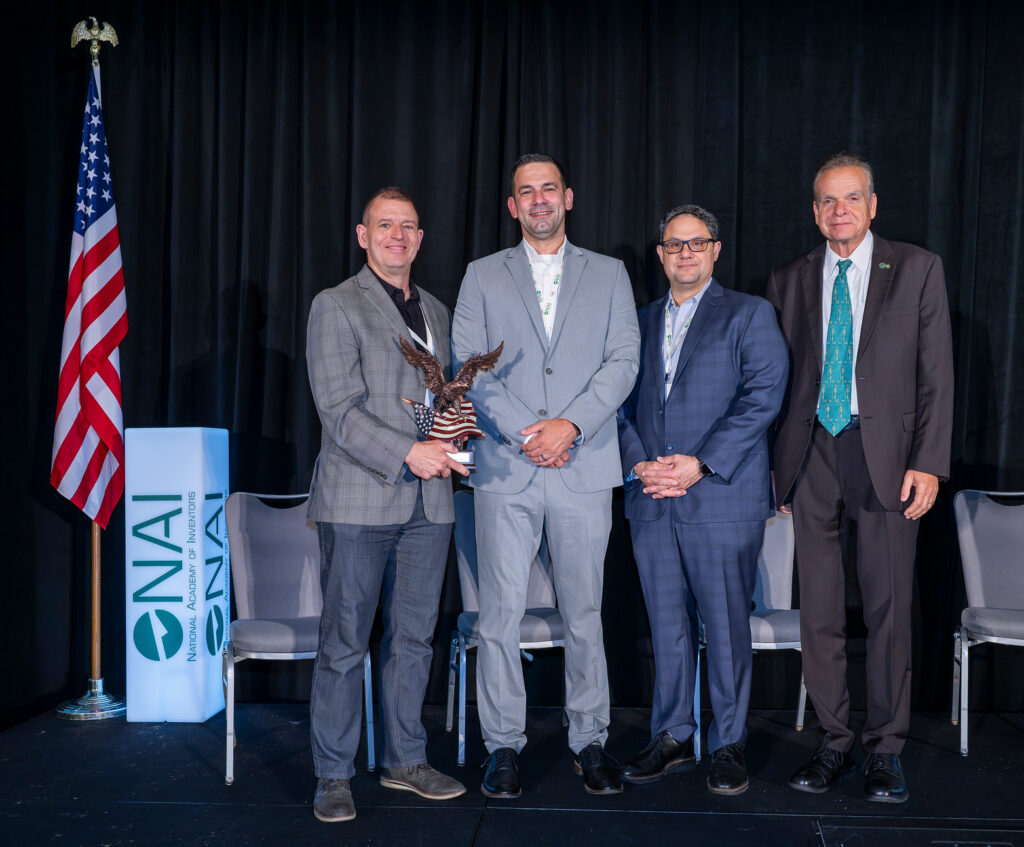
Inagural Collegiate Joint Service Innovation Award, 2026

Held at the NAI Annual Conference, the Innovation Exchange brings together accomplished and emerging inventors from across NAI Member Institutions and the broader NAI community. Featuring exceptional inventions from universities, industry, national laboratories, military institutions, and the next generation of young innovators, NAI’s Innovation Exchange provides a distinguished national stage to share discoveries, celebrate ingenuity, and build connections across generations, disciplines, and institutions.

Introduced in 2026 as an expansion of the Innovation Exchange, the NAI Innovation Alliance (NAIIA) & Command Strategies Joint Service Innovation Award honors exceptional student inventions within the U.S. Military. The award is part of the NAI Innovation Alliance (NAIIA) & Command Strategies Joint Service Innovation Challenge, the nation’s premier recognition for cadet and midshipman innovation. It is reserved for the most distinguished research and invention talent across the Service Academies and ROTC programs. Recognized annually at the NAI Annual Conference, the award celebrates inventions and innovations with the potential to address critical challenges facing the military, strengthen national security, and improve the lives of those who serve.

Apply for the Innovation Exchange today! Applicants who meet the eligibility for the Joint Service Award will automatically be considered for the award. Questions? Contact Akira Mitchell at [email protected].

Joint Service Innovation Award Recipients

Joseph Hanus

West Point, 2026

Eligibility FAQs

Where and when is the Challenge being held?

The Challenge and Award selection will take place at NAI’s Annual Conference in Arlington, Texas, June 14-17, 2027. Finalists
attend the full Annual Conference and recieve an exclusive private tour of the National Medal of Honor Museum. Finalists will receive a detailed itinerary with arrival and presentation times when finalists are announced in the spring of 2027.

Who can apply?

Cadets and midshipmen from the Federal Service Academies, Senior Military Colleges, and Collegiate ROTC programs are invited to apply. The challenge is open to individuals and teams.

How many teams may we nominate?

Institutions may nominate multiple teams. Finalist positions are limited and awarded on merit.

Who from my team can attend the event?

Team representation will be determined by the instiution upon the announcement of the finalists. Representation may include some combination of student team members, a faculty advisor, an institutional leader.

Does a project need a working prototype?

Any Technical Readiness Level is welcome. Inclusion of validated results or a working demonstration strengthen a submission.

Which technology areas qualify?

Any defense or national security innovation that can be presented at the UNCLASSIFIED level.

Submission Requirements

Applications require a written and video submission. The full submission template and guide can be found here.

Written Submission  2–3 pages, graphics included

  • Executive Overview: 200–300 word Bottom Line Up Front (BLUF)
  • Innovation Challenge Area: the gap and why the status quo falls short
  • Proposed Solution: architecture, science, or engineering design
  • Technology Readiness Level (TRL): level, justification, milestones
  • Competitive Advantages: innovation, feasibility, impact
  • Point of Contact (POC): name, phone, email

Video Submission  1–3 minutes

  • .mov, .mp4, .gif, or a YouTube link
  • Filmed in a well-lit, quiet setting
  • Clearly conveys the invention’s significance
  • Includes a demonstration whenever possible

Deadlines

  • Applications Open: October 27, 2026
  • Applications due: January 29, 2027
  • Finalists announced: End of March 2027
  • Student Showcase invitations sent: Early April 2027
  • Student Showcase: June 2027, held at the NAI Annual Conference
  • Award Winners announced: June 2027, during the NAI Annual Conference

Judging Criteria

Judges score six criteria from 0 to 5, for a maximum of 30 points. Top scores reflect:

  • Mission Relevance: Direct alignment to a critical defense priority.
  • Innovation and Originality: A novel approach distinct from existing solutions.
  • Demonstrated Capability: A fully functional demonstration with validated performance.
  • Feasibility & Scalability: A scalable solution with a clear transition path.
  • Operational Impact: Significant, transformative improvement to mission outcomes.
  • Presentation & Communication: A clear, compelling, well-organized delivery.